Artificial intelligence is changing how websites are built. Today, AI website builders can generate layouts, write content, suggest images, and launch a basic website in minutes. At the same time, WordPress continues to power a large portion of the internet because of its flexibility, scalability, and long-term control. The right choice depends less on which platform is “better” and more on what you actually need your website to do.
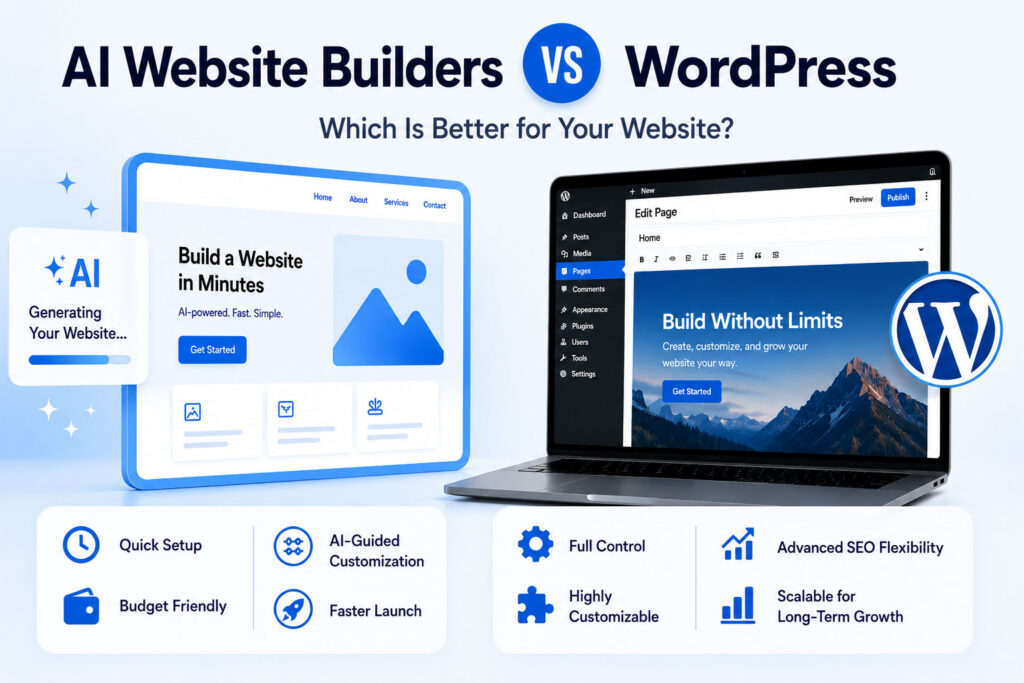
If you need a simple website quickly with minimal setup, an AI website builder may be the easier option. If you want stronger customization, long-term growth potential, and more control over SEO and functionality, WordPress is usually the better investment.
What Is an AI Website Builder?
AI website builders are platforms that use artificial intelligence to automatically generate websites based on prompts, business categories, or short questionnaires.
Instead of designing pages manually, users answer a few questions about their business and the platform creates a website layout, suggested content, colors, navigation, and images automatically.
Popular AI website builders include platforms like Wix, Squarespace, and Hostinger Website Builder. These tools are designed for speed and simplicity rather than deep customization.
What Makes WordPress Different?
WordPress is a content management system that gives users far more control over how a website functions, looks, and grows over time.
Unlike most AI website builders, WordPress is open and highly extensible. You can choose your own hosting provider, install custom themes, optimize SEO settings, add advanced plugins, build membership systems, create marketplaces, launch blogs, or integrate AI tools directly into the site.
WordPress requires a bit more setup and maintenance, but it offers significantly more flexibility in the long run.
Choose an AI Website Builder If You Want Simplicity
For many small businesses, creators, or local organizations, AI website builders solve a very real problem: getting online quickly without dealing with technical details.
An AI website builder may be the right choice if you:
- Need a basic website fast
- Have a small budget
- Do not want to manage hosting, updates, or plugins
- Prefer an all-in-one platform
- Are comfortable with limited customization
- Only need a brochure-style website
For example, a local photographer, restaurant, consultant, or startup landing page may work perfectly well on an AI-driven platform.
The biggest advantage is convenience. Most of the technical setup is handled automatically, which lowers the barrier to launching a website.
Choose WordPress If You Want Long-Term Flexibility
WordPress becomes more valuable as your website grows. If your goals include content marketing, SEO, lead generation, advanced functionality, or scaling over time, WordPress usually provides more room to expand.
WordPress is often the better choice if you:
- Want full control over design and functionality
- Care heavily about SEO
- Plan to publish a large amount of content
- Want custom integrations or plugins
- Expect your website to evolve over time
- Need ownership and portability
- Want to avoid platform limitations later
For example, websites that eventually need directories, memberships, AI assistants, marketplaces, advanced forms, or custom workflows often outgrow simpler AI builders.
WordPress also gives businesses more direct control over technical SEO elements such as schema markup, metadata, site architecture, page speed optimization, and structured content strategies.
WordPress and AI Are Becoming More Connected
Artificial intelligence is rapidly changing how websites are built and managed, and WordPress is evolving alongside that shift. While many AI website builders focus on simplicity and automation, WordPress gives businesses more flexibility in how they use AI across their website and content strategy.
Instead of relying on a single built-in AI system, WordPress allows site owners to integrate a wide range of AI tools for content creation, SEO, automation, customer support, and publishing workflows. This has become increasingly important for businesses that want more control over how AI is used throughout their website.
For example, AI can now assist with drafting articles, improving metadata, generating images, creating content summaries, optimizing pages for search engines, and even powering on-site AI assistants. Because WordPress is highly extensible, businesses can choose the tools and workflows that best fit their goals rather than being limited to a closed platform.
This flexibility also makes WordPress appealing for long-term growth. As AI continues to influence search, publishing, and online discovery, many businesses want a platform that can adapt alongside those changes. WordPress is increasingly being used not just as a website platform, but as a foundation for AI-assisted publishing and digital content workflows.
The SEO Difference Matters
One of the biggest long-term differences between AI website builders and WordPress is SEO flexibility. While many AI website builders now include solid basic SEO features, WordPress still provides more advanced control for businesses focused on organic traffic, publishing, and long-term search visibility.
With WordPress, site owners generally have more direct control over technical SEO settings, site structure, schema markup, internal linking, and performance optimization. The platform also supports a wide range of SEO plugins and AI-assisted workflows that can help businesses scale content creation and improve how pages are organized for both traditional search engines and emerging AI-driven search experiences.
This flexibility becomes increasingly important for websites that plan to grow over time. Businesses investing in content marketing, Answer Engine Optimization (AEO), or larger publishing strategies often need the ability to customize and expand their SEO approach beyond the limitations of a simplified website builder.
AI Website Builders Are Improving Quickly
It is important to note that AI website builders are improving rapidly. Many platforms now offer AI-generated copy, automated layouts, AI image generation, SEO suggestions, and even AI business assistants. For some users, these tools are more than enough.
The gap between simplicity and capability is shrinking. Still, there is usually a tradeoff between convenience and control. The easier a platform is to manage, the more limitations it typically has behind the scenes.
The Best Choice Depends on Your Goals
There is no universal answer to the AI website builder vs WordPress debate. If your priority is launching a clean, functional website quickly with minimal effort, an AI website builder may be the smartest choice.
If your priority is long-term growth, customization, SEO strategy, and ownership, WordPress remains one of the strongest platforms available.
In many cases, businesses start with simplicity but eventually move toward flexibility as their website becomes a more important part of their operations.