AI video creation is moving fast. New tools, new models, and new workflows are constantly being introduced, and on the surface, many of them seem to do the same thing. But once you actually dig in and try to build a repeatable system, it becomes clear that choosing the right setup to fit your needs can be a bit overwhelming with the many different options.
This is a breakdown of that process, what we’ve been testing, what actually matters and how to think about AI video tools if your goal is consistency, not constant trial and error. Most people approach AI video creation as a creative exercise. They test prompts, adjust outputs, and try different styles. That works for one-off videos, but it doesn’t hold up if you want to produce content consistently.
A scalable system requires structure. Instead of asking, “What can this tool create?” the better question is, “Can this tool produce the same type of video repeatedly with minimal effort?” This is where many platforms fall short. They generate impressive results, but they rely too heavily on manual input and variation. That makes them difficult to standardize. For ongoing content production, we’ve found that consistency and ease of use its what matters most.
Understanding the Different Types of AI Video Tools
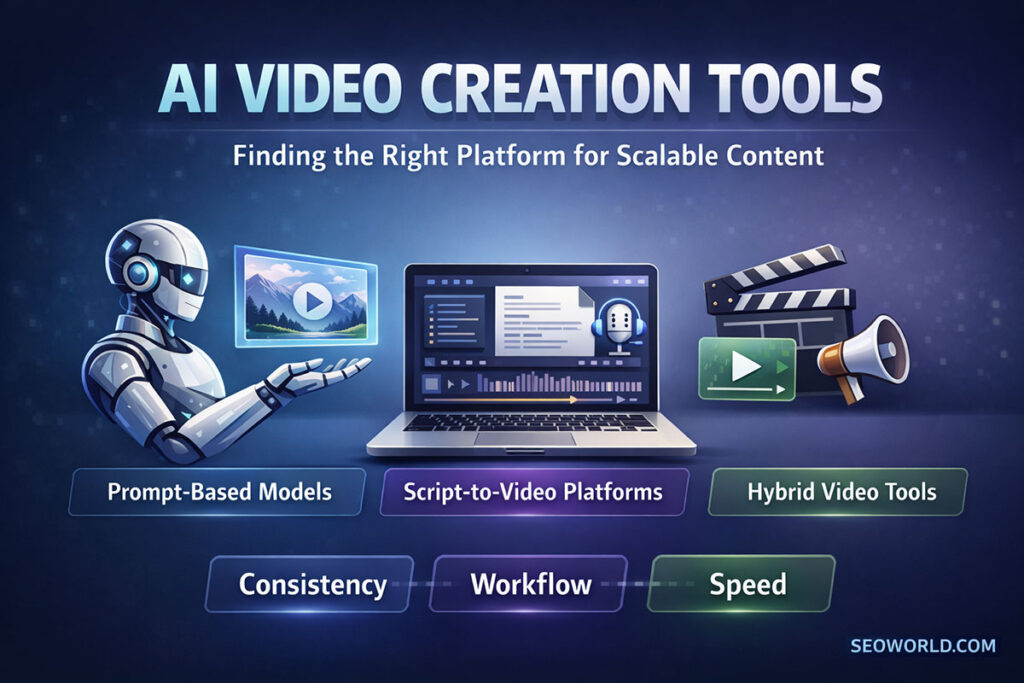
Most AI video platforms fall into one of three categories, and each one serves a different purpose depending on your goals.
Prompt-to-video tools are built around generating visuals directly from text prompts. These platforms tend to produce the most visually impressive outputs and are often powered by newer AI models. They are useful for creative concepts, visual storytelling, and experimentation, but they are harder to control when you need consistent structure across multiple videos.
Some examples of prompt-to-video tools include platforms like Runway, Pika, and Kaiber. These tools focus heavily on generating visuals directly from prompts and are often used for creative or experimental content. They can produce impressive results, but maintaining consistency across multiple videos can be challenging.
Script-to-video platforms take a more structured approach. Instead of generating everything from a prompt, they convert written content into scenes, visuals, and voiceovers. This makes them far more predictable and better suited for educational content, explainers, and SEO-driven videos. If your goal is repeatable production, this category is usually more practical.
Examples of script-to-video platforms include Topview.ai, Pictory, and Synthesia. These tools are designed to take structured input and turn it into usable video output, making them a good fit for repeatable workflows and content production systems.
Hybrid tools attempt to combine both approaches. They accept prompts but also introduce structure, templates, and automation. These can be powerful, but their effectiveness depends on how well they balance flexibility with consistency. In many cases, they either feel too rigid or still require too much manual input.
Hybrid tools include platforms like InVideo AI and Lumen5, which combine prompt-based generation with structured editing and templates. These tools aim to balance flexibility and usability, though the level of control and consistency can vary depending on how they are used.
Comparing AI Video Models vs AI Video Platforms
One of the biggest points of confusion is the difference between AI video models and AI video platforms.
Model-driven tools, such as newer generative systems, focus on output quality. They are designed to produce high-end visuals and push the boundaries of what AI video can do. However, they are not always built for production workflows. They often require detailed prompting, manual adjustments, and ongoing experimentation.
Platform-driven tools, on the other hand, are designed around usability. They prioritize speed, structure, and repeatability. Instead of focusing on what is possible, they focus on what can be produced consistently.
For most content-driven use cases, especially SEO and informational videos the platform approach tends to be more effective. It reduces decision-making and allows you to focus on content rather than production.
What Actually Matters When Choosing an AI Video Tool
When comparing tools, it’s easy to get distracted by features. In practice, a few core factors determine whether a platform is viable long term.
Input consistency is one of the most important. If your process requires rewriting prompts or restructuring content every time, it will slow you down. A good system allows you to reuse the same format repeatedly.
Output predictability is just as critical. You should be able to expect similar results from similar inputs. If the output varies too much, it becomes difficult to scale production.
Speed also plays a major role. The time it takes to go from idea to finished video often matters more than small differences in quality. Faster production allows for more content, more testing, and better overall results.
Finally, editing requirements should be minimal. If every video requires significant adjustments after generation, the efficiency gains disappear. The best tools reduce the need for post-production rather than shifting the workload.
Building a Repeatable AI Video Workflow
A reliable AI video system is not built around a single tool. It is built around a structured process.
It usually starts with a consistent script format. This might include a clear opening, a defined explanation section, a comparison or breakdown, and a concise summary. Keeping this structure consistent makes it easier for AI tools to generate usable output.
From there, the script is fed into a video platform that converts it into scenes and visuals. Some systems include voice generation, while others allow you to add narration separately.
The final step, if needed, is light editing. The goal is to keep this minimal. If the process requires extensive editing, it is a sign that the system needs refinement.
Over time, this workflow becomes predictable. Instead of creating each video from scratch, you are running a process.
Choosing the Right Tool for Your Use Case
Different tools are better suited for different objectives, and the right choice depends on what you are trying to achieve.
If your focus is on high-end visuals or creative experimentation, model-driven tools are worth exploring. They offer more flexibility and can produce unique results, but they require more time and effort.
If your goal is consistent content production, especially for SEO or informational topics, structured platforms are typically a better fit. They allow you to create videos quickly and maintain a consistent format.
For most content-driven websites and platforms, the second approach is more sustainable. It aligns with how content is actually produced and consumed.
Using AI Video Tools for SEO and Content Growth
AI video creation can play a meaningful role in SEO when used correctly. Videos can support written content, improve engagement, and expand visibility across platforms.
The key is alignment. Videos should follow the same structure and intent as the content they support. This includes targeting specific topics, answering clear questions, and maintaining a consistent format.
Over time, this creates a content ecosystem where written and video content reinforce each other. Instead of isolated pieces, you build a connected system that grows more effective with scale.
Final Thoughts on AI Video Creation
AI video tools are improving quickly, but the core challenge remains the same. The difficulty is not generating a video. It is creating a system that allows you to produce videos consistently without friction.
Once that system is in place, the tools become more effective. Instead of driving the process, they support it, allowing you to produce content more efficiently and with greater consistency.
The real advantage comes from removing uncertainty. When you no longer have to rethink your approach each time, production becomes faster, easier, and more scalable.
That is where AI video creation starts to deliver real value.