How to Optimize for AI Search, Answer Engines, and Modern SEO
AI optimization is the process of structuring content, pages, and websites so they can be clearly understood, interpreted, and used by AI-driven search systems. As search continues to evolve beyond traditional rankings into AI-generated answers, featured snippets, and conversational results, visibility now depends less on where a page ranks and more on whether its content can be used.
This shift changes the role of a webpage. Instead of being only a destination, a page becomes a source of structured information that can be extracted, summarized, and presented directly to users. AI optimization focuses on making that possible in a consistent and measurable way.
AI optimization is a broader concept that includes search engine optimization, answer engine optimization, and content structuring for AI interpretation. It is not limited to rankings or keywords. It is focused on how information is understood and used.
Where SEO helps pages get discovered, and answer-focused strategies help content get selected, AI optimization connects both. It ensures that once a page is found, it can also be interpreted and used effectively.
How AI Search Is Changing Optimization
Search is no longer just a list of links. AI systems now generate answers by interpreting multiple sources and presenting information in a single response.
This changes the goal of optimization. It is no longer only about earning a click. It is about being included in the answer itself.
A page may not rank first in traditional results and still be used in AI-generated responses if the content is clear, structured, and directly aligned with user intent. This creates a new layer of visibility that depends on usability rather than position alone.
AI Optimization vs SEO vs AEO
SEO focuses on discoverability and rankings. It helps search engines understand what a page is about and where it should appear.
Answer-focused optimization focuses on how content is extracted and used in direct responses. It emphasizes clarity, structure, and the ability to answer specific questions.
AI optimization sits above both. It combines discoverability with extractability and extends the focus to how systems interpret and present information.
For a deeper explanation of answer-focused strategies, see AEO What Is Answer Engine Optimization.
The SEOWORLD AI Optimization Model
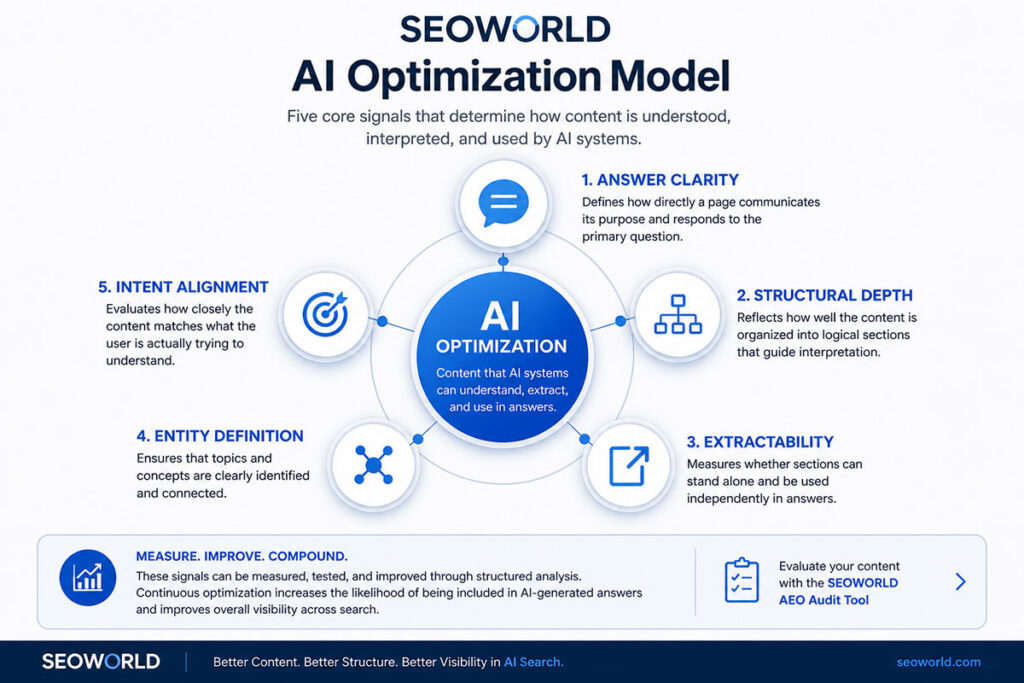
AI optimization becomes more practical when it is defined as a system rather than a set of general ideas. The SEOWORLD AI Optimization Model is built around five core signals that determine whether content can be effectively used by AI systems.
Answer Clarity defines how directly a page communicates its purpose and responds to the primary question.
Structural Depth reflects how well the content is organized into logical sections that guide interpretation.
Extractability measures whether sections can stand alone and be used independently in answers.
Entity Definition ensures that topics and concepts are clearly identified and connected.
Intent Alignment evaluates how closely the content matches what the user is actually trying to understand.
These signals work together. A page that performs well across all five is significantly more likely to be interpreted correctly and used in AI-driven results.
How AI Optimization Is Measured
AI optimization is not abstract. It can be evaluated through measurable signals that reflect how a page performs in answer-driven environments.
Pages can be analyzed for answer readiness, which indicates how easily the content can be understood and used. Extractability shows whether sections are structured in a way that allows them to be reused. Question matching evaluates how well the content aligns with common user queries and expectations.
These signals form the foundation of how AI systems assess content. They also provide a practical way to identify weaknesses and improve pages over time.
Example: Improving AI Readability and Extractability
Consider a simple example of how structure changes usability.
A typical opening paragraph might read:
“AI optimization is becoming increasingly important as search engines evolve and new technologies change how users interact with information online.”
This introduces the topic but does not clearly answer anything.
A more effective version would be:
“AI optimization is the process of structuring content so it can be clearly understood and used by AI-driven search systems.”
The second version works better because it provides a direct, self-contained answer. It can be extracted, quoted, or used in a generated response without additional context.
This same principle applies across an entire page. When sections are written as clear, independent units, they become significantly more useful in AI-driven environments.
How to Optimize Content for AI Systems
Optimizing for AI requires a shift in emphasis rather than a completely different process.
Pages should begin with a clear explanation of the topic. The opening section often determines whether content can be used in answer-driven results.
Content should be organized into well-defined sections that reflect how users think about a topic. Each section should focus on a single idea and be written so it can stand on its own.
Clarity should take priority over length. Concise, direct explanations are more effective than longer sections that dilute the main point.
The overall structure should guide both users and systems through the content in a predictable and logical way.
Common Mistakes in AI Optimization
Many pages still follow patterns that limit their usefulness in AI-driven environments.
Some focus too heavily on keywords without clearly answering the underlying question. Others introduce topics but delay providing a direct explanation.
Unclear structure is another common issue. When sections are not well defined, it becomes difficult for systems to interpret and extract information.
Excessive length without clear purpose can also reduce effectiveness. More content does not improve visibility if it reduces clarity.
Where AI Optimization Applies
AI optimization applies across nearly every type of page on a website.
Informational content benefits from clearer answers and stronger structure. Service and product pages benefit from direct explanations of offerings and value.
Even pages such as About or Contact pages can improve their usefulness by clearly stating purpose and next steps.
As AI systems evaluate entire websites, consistency in structure and clarity becomes increasingly important.
AI Optimization and the Future of Search
The most important shift in search is not rankings, but usability.
As AI systems become more integrated into how information is delivered, the value of content will depend on how easily it can be interpreted and used.
Pages that are clear, structured, and aligned with intent will continue to perform well across both traditional search and AI-driven results.
Tools and Next Steps
Understanding AI optimization is only the starting point. Improving it requires evaluation and refinement.
Analyzing how a page performs across answer clarity, structure, and extractability provides a clear path for improvement. These signals make it possible to move beyond general advice and apply optimization in a measurable way.
This is where structured tools and analysis become valuable, helping identify what is working, what is unclear, and how content can be improved for both search visibility and AI usability.